Hardware Design Projects
A 16-bit CPU, a CNN accelerator and a neural-network RTL core on Zynq
My role — individual coursework: each design below is my own RTL, verification and implementation, end to end.
16-bit single-cycle CPU in VHDL
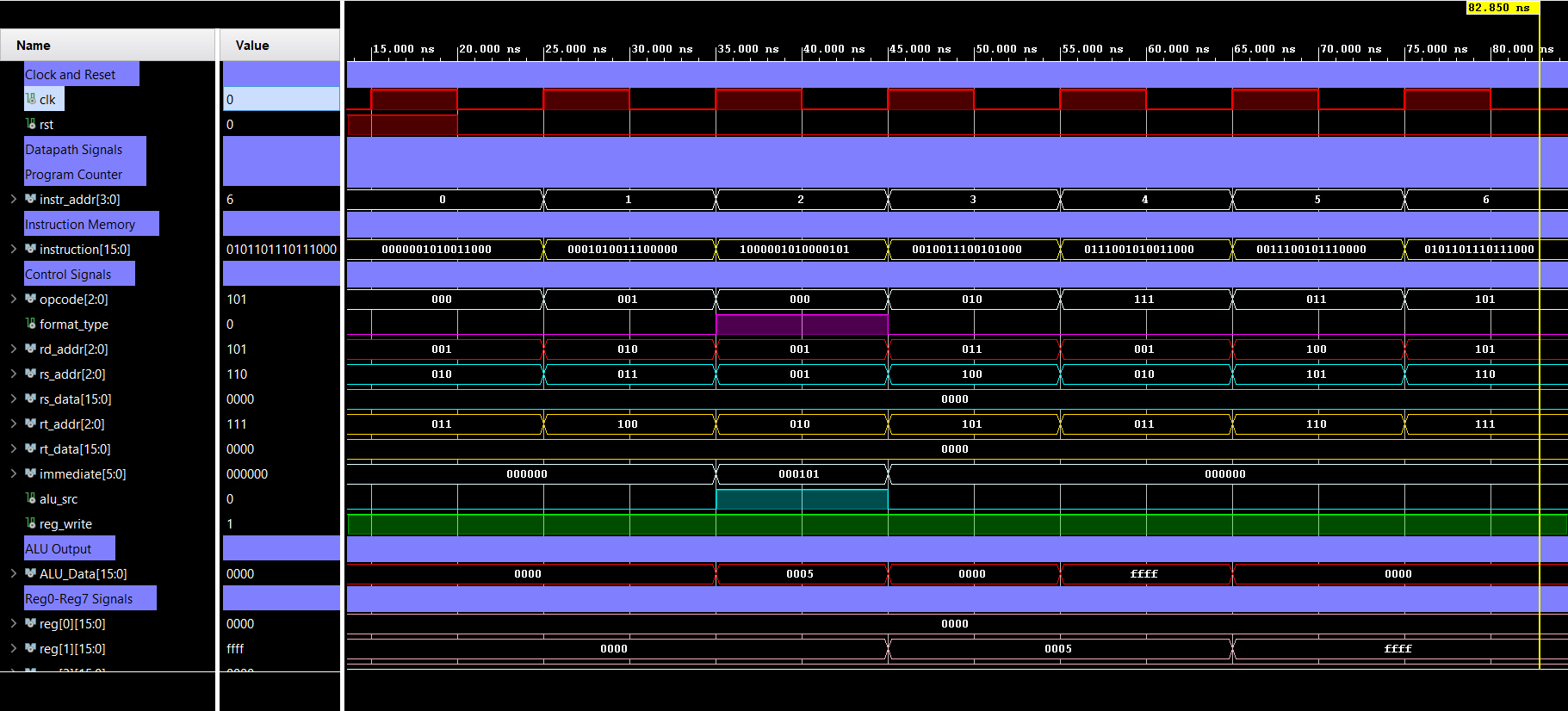
Full datapath on Zynq-7020 — ALU with eight operations, 8×16-bit dual-read register file, 16-entry instruction memory, program counter and control unit, with R-type and I-type instruction formats. Functionally verified in simulation and timing-closed.
| Synthesis on Zynq-7020 (xc7z020) | |
|---|---|
| LUTs | 207 / 53,200 (0.39%) |
| Flip-flops | 132 / 106,400 (0.12%) |
| I/O | 18 / 200 |
| Maximum clock frequency | 143.0 MHz |
| Worst negative slack | +0.114 ns |
| Worst hold slack | +0.355 ns |
Tools — VHDL, Vivado synthesis and implementation, behavioural simulation. code (ECE 575)
CNN accelerator on PYNQ-Z2
Hardware/software co-design taken end to end: PyTorch training (95.80% accuracy on the 43-class GTSRB dataset), Vitis HLS synthesis, INT8 quantisation and AXI deployment. 89% hardware accuracy at 101 MHz using 55% of available LUTs. Tools — PyTorch, Vitis HLS, Vivado, PYNQ. (ECE 554)
MNIST neural network in RTL
Pipelined MAC engines in VHDL for a fully-connected network. Fixed-point weights held in BRAM, deployed on Zynq-7020 over AXI-Stream with ARM DMA. Tools — VHDL, Vivado, AXI-Stream, ARM DMA. (ECE 5752)
Related journal work compares machine learning models for financial time-series prediction, published in PLOS ONE (2023).