Abbas Ali
PhD Student, Electrical and Computer Engineering · University of Michigan-Dearborn

Information Systems, Security,
and Forensics (ISSF) Lab
4901 Evergreen Road
Dearborn, MI 48128
I am a PhD student and NSF-funded Graduate Student Research Assistant in the Department of Electrical and Computer Engineering at the University of Michigan-Dearborn, where I work in the Information Systems, Security, and Forensics (ISSF) Laboratory with Prof. Hafiz Malik.
My research is on securing cyber-physical systems at the hardware level. Modern vehicles and connected devices contain dozens of embedded computers, and the assumption that each one is genuine and untampered with is rarely verified. I build systems that check that assumption directly — using the physical characteristics of the silicon itself.
Specifically, I work on:
- Hardware fingerprinting — identifying devices by manufacturing variations unique to each chip
- FPGA-based intrusion detection — detection that runs in real time, in the vehicle, rather than in the cloud
- Side-channel analysis — using electromagnetic and power measurements to detect tampering and counterfeit components
Before starting my PhD I spent two years as an FPGA engineer, building high-performance digital systems in production. I received my BS in Electrical Engineering from the University of Engineering and Technology, Peshawar, graduating as a gold medalist.
Research in Action
From bench to conference floor
A device does not need to announce what it is. Manufacturing leaves every chip with slightly different switching behaviour — overshoot, ringing, settling time. An attacker can copy firmware, a serial number, or a message. They cannot copy physics.
-
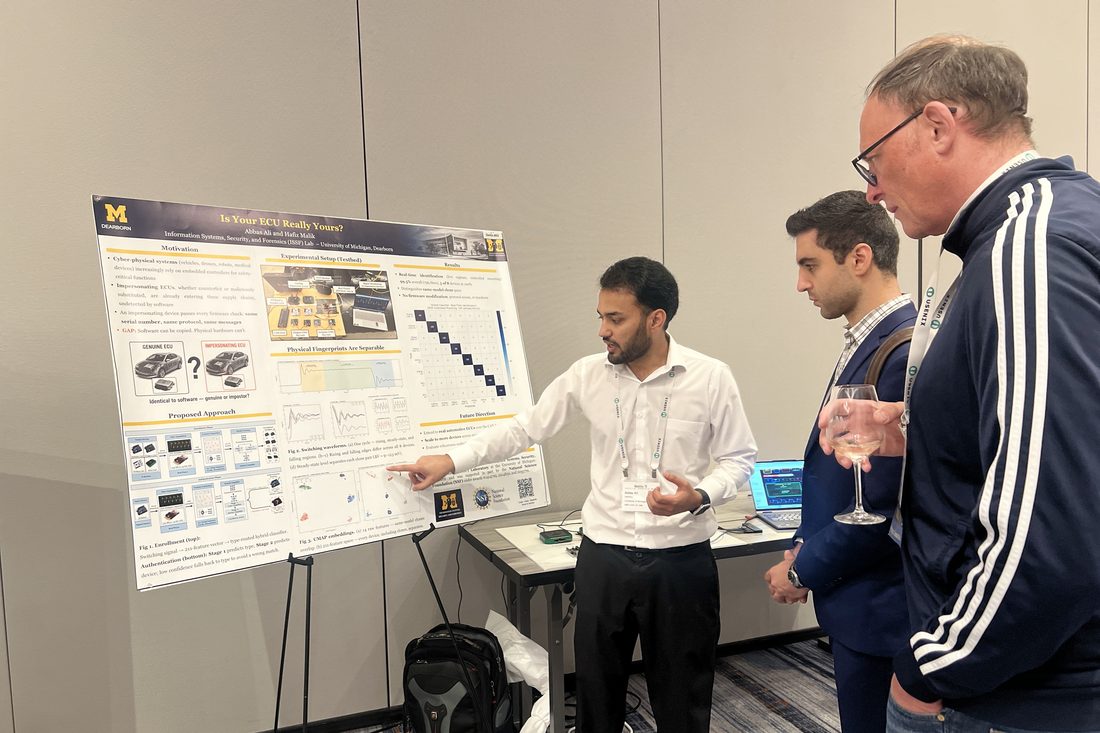 Baltimore · the demo
Live on the table
Real devices at VehicleSec ’26, identified in real time purely from the analog shape of their switching signals.
Demo abstract -
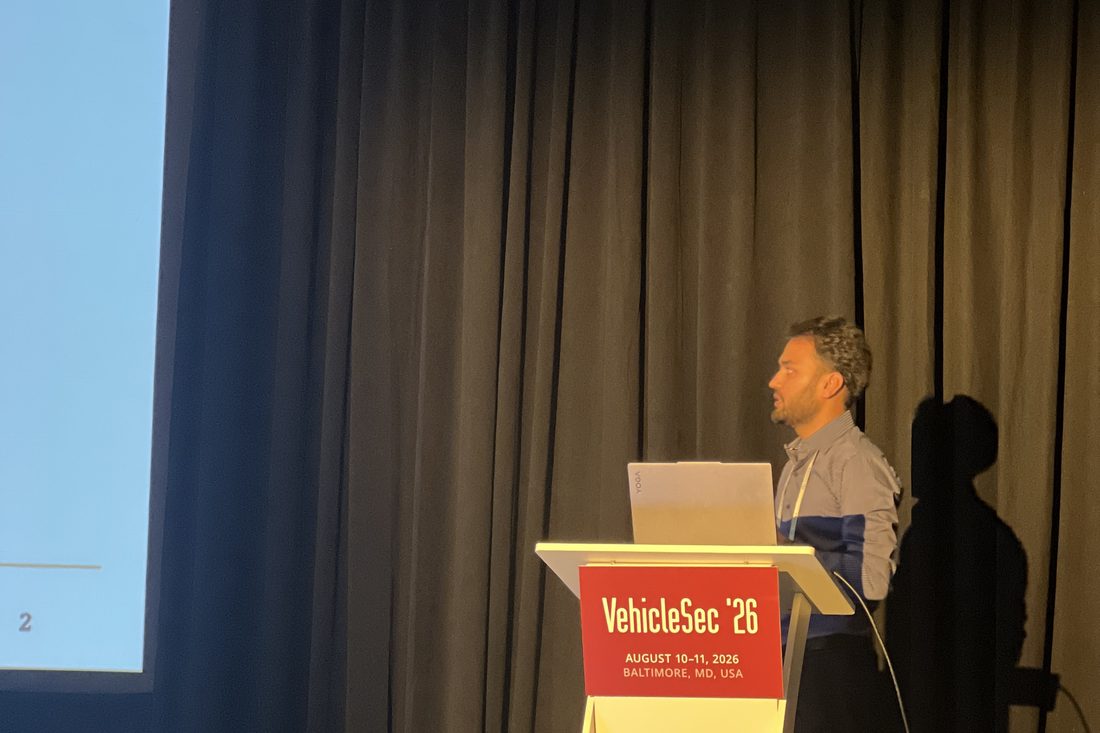 Baltimore · the talk
Is Your ECU Really Yours?
The paper talk, alongside a lightning talk extending the method to production ECUs over the CAN bus.
Read the paper -
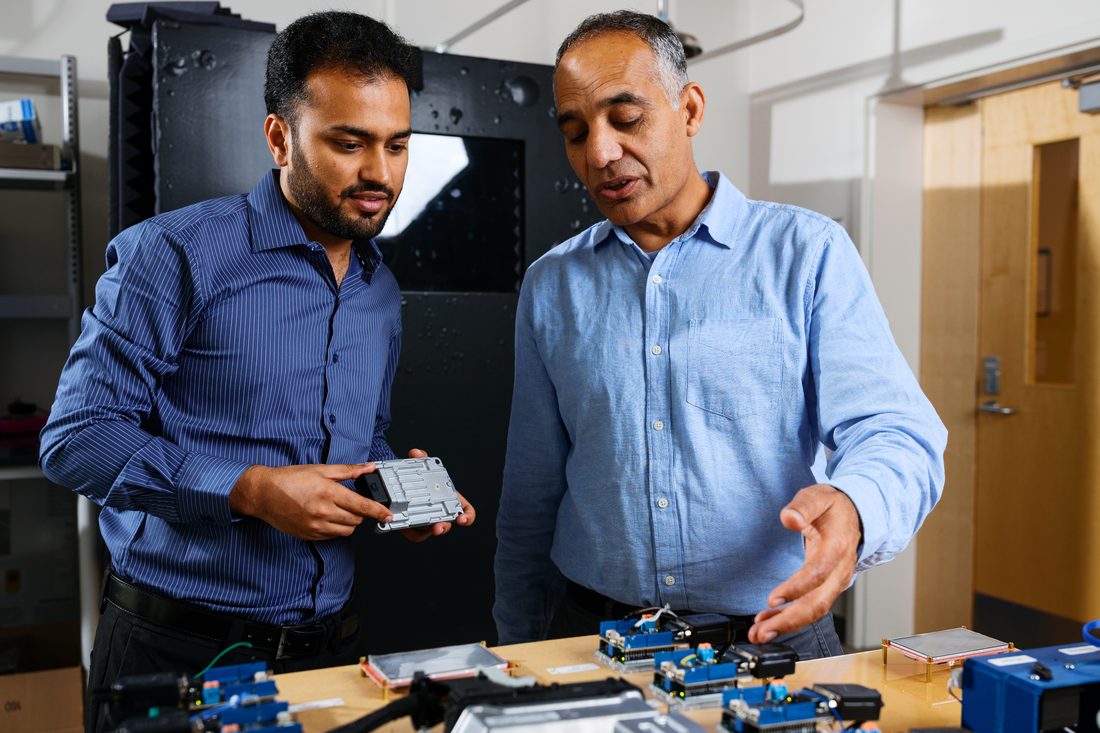 The mechanism
Physics as identity
Two chips off the same reel switch slightly differently. That difference is measurable, and it is not something firmware can rewrite.
-
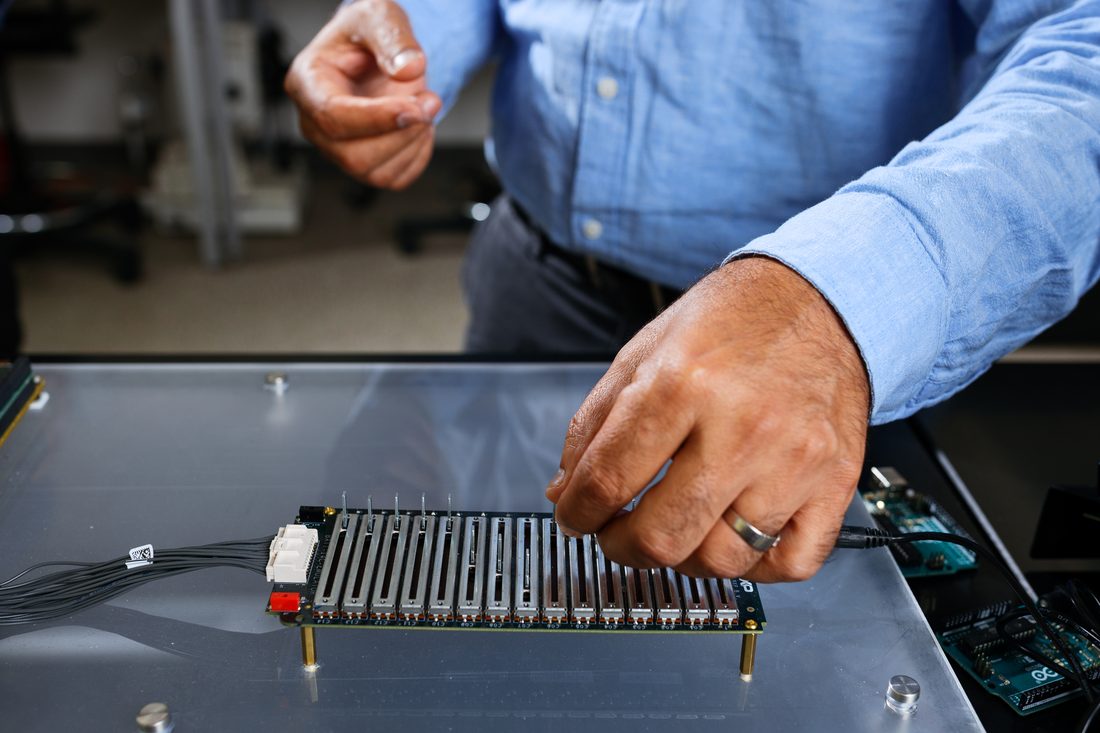 The bench
Same make, same model
Eight devices across four hardware types, including boards of the same make and model.
99.5% real-time accuracy — no firmware changes, no protocol access
-
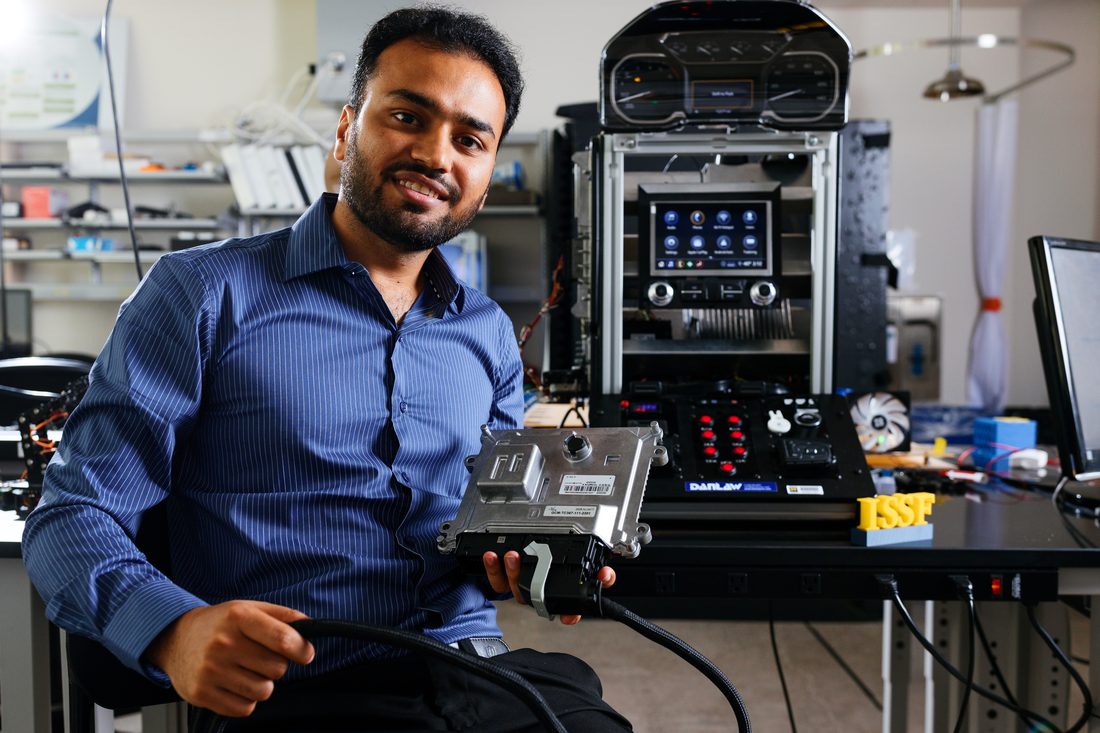 Production hardware
Nine real ECUs, weeks apart
Electrically identical production automotive ECUs, captured across thirteen sessions over several weeks. A fingerprint that holds only within one sitting cannot be deployed.
Drifting — hover to pause, click to hold
news
| Sep 15, 2026 | Real-Time Authentication of Embedded Hardware has been accepted at EAI SmartSP 2026. |
|---|---|
| Aug 25, 2026 | Featured in UM-Dearborn’s Research with Purpose on fully funded graduate programs. |
| Aug 01, 2026 | Presented Short: Is Your ECU Really Yours? at USENIX VehicleSec 2026 in Baltimore. |
| Apr 17, 2026 | Won the graduate division of the student poster competition at the 2026 CCAT Global Symposium on Mobility Innovation, Ann Arbor. |
| Aug 01, 2025 | Our paper A Lightweight IDS Framework Using FPGA-Based Hardware Fingerprinting on Zynq SoC appeared at IEEE CSR 2025 in Chania, Greece. |
| Jan 06, 2025 | Started my PhD in Electrical and Computer Engineering at the University of Michigan-Dearborn, funded by the NSF. |
| Jun 01, 2024 | First-author paper Speed vs. efficiency: A framework for high-frequency trading algorithms on FPGA using Zynq SoC platform published in Alexandria Engineering Journal. |
| Sep 21, 2023 | Our paper A performance comparison of machine learning models for stock market prediction with novel investment strategy published in PLOS ONE. |
selected publications
- EAI SmartSPReal-Time Authentication of Embedded HardwareIn 4th EAI International Conference on Security and Privacy in Cyber-Physical Systems and Smart Vehicles (SmartSP), 2026Accepted


