HFT Indicators on FPGA
First documented hardware architectures for Aroon, MACD and RSI
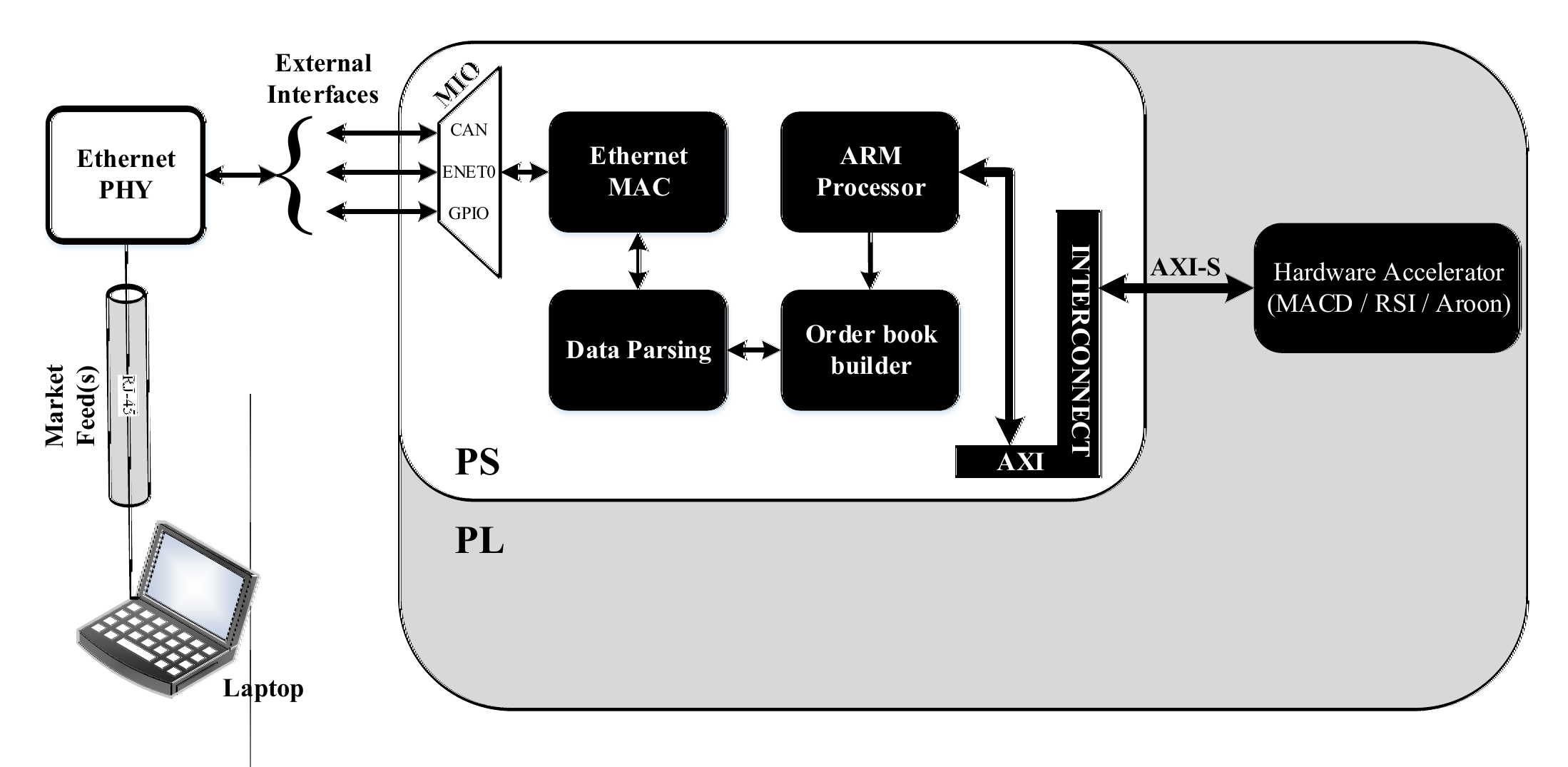
High-frequency trading competes on microseconds, yet no hardware implementations of the standard technical indicators existed in the literature. Designed the first documented architectures for Aroon, MACD and RSI on Xilinx Zynq SoC, with the latency-critical datapaths in programmable logic and everything else in software on the ARM core.
The division problem
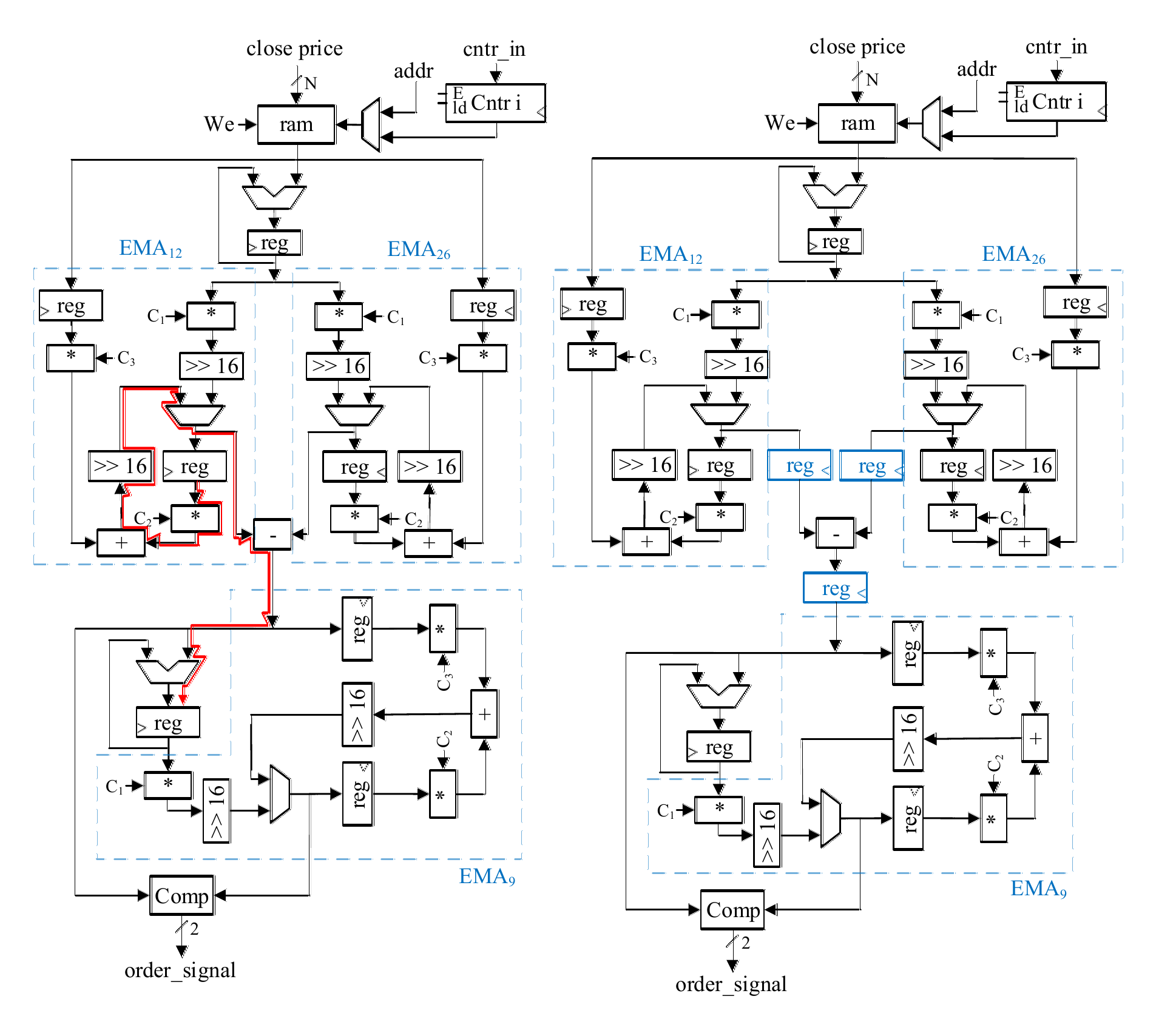
MACD required six hardware dividers, and synthesis time had become impractical. Rather than spend area on them, reformulated the smoothing constants so each division collapsed into a constant multiply and a right shift — which costs nothing in hardware. All six dividers removed, and the longest path shortened.
Results
| Speed-up over the ARM software baseline | 30× |
| MACD and RSI throughput | within 0.38 µs of each other — close enough to run concurrently |
| RSI divider microarchitectures compared | 3, from combinational to fully pipelined |
| Latency techniques | critical-path analysis, pipelining, folding, circuit replication |
| Platform | Xilinx Zynq-7000 SoC (ZedBoard) |
My role — lead designer and first author: indicator architectures, the divider reformulation, critical-path optimisation, and the PS-vs-PL comparison.
Tools — VHDL, Vivado, ModelSim, MATLAB reference models, C on the ARM core for the software baseline.
Links — paper (Alexandria Engineering Journal, 2024) · code: FYP_project · diagrams and docs: Academic-Work